
AI Makes Telematics Smarter. People Make It Work.
A lot of telematics platforms are getting smarter.
That is a good thing. Better event detection, faster video review, and stronger pattern recognition all have real value.
But, making telematics smarter and making a telematics program successful are not the same thing.
As we wrote in The Real Barrier to Telematics Success Isn’t What You Think, telematics programs usually break down for operational and human reasons, not technical ones. This AI discussion fits into that same reality. Better tools help. They do not remove the need for execution.
Where AI Actually Helps
There are real use cases where AI earns its keep.
Forward-facing cameras can help identify recurring risky behaviors like habitual tailgating. AI can also help sort through a large volume of footage and bring the most important clips to the surface faster. That can be useful in a first notice of loss workflow, where speed matters and nobody has time to manually review everything.
AI can also help connect dots across large amounts of data. A single event may not mean much. Patterns of speeding, close following distance, and aggressive driving over time are more meaningful. AI can help surface these faster than a person can.
Used properly, AI can make a program more efficient. It can help teams focus attention where attention is needed. But that is where the line should be drawn. More efficient is not the same thing as more effective.
Where AI Falls Short
The problem is not detection. The problem is what happens after detection.
If every event becomes an alert, and every alert feels urgent, drivers and fleet managers stop paying attention. That is just human nature. A system that notifies on everything ends up diluting the things that actually matter.
This is one of the reasons restraint matters. Just because a camera or algorithm can flag something does not mean it always should. Someone still has to decide what rises to the level needing intervention, what is part of a broader pattern, and what is just noise.
There is also still the issue of context.
AI event detection has improved, but it is not perfect. False positives still happen. Situations still need interpretation. If not used carefully, AI can become an echo chamber. This is concerning when jobs, performance reviews, or coaching conversations are involved. A person has to look at the event and decide whether the system got it right and whether the response is fair.
The bigger limitation, though, is this: AI can tell you what happened. It cannot make a driver care.
AI cannot sit down with a driver and explain why the program exists. It cannot answer the quiet question every human driver has: “What is in this for me?”.
That matters more than people think.
In our recent post What’s In It for Me?, we made the point that drivers are much more likely to buy into a program when the benefits are clear to them. Protection. Exoneration. Less risk. More fairness. A well-run program is not supposed to feel like a trap. It is supposed to feel like something that helps good drivers get home safely and get credit for doing the job right. That kind of buy-in does not come from an app notification. It comes from human-to-human interaction.
Behavior Change Is Still a Human Process
This is where a lot of AI-heavy telematics strategies go sideways.
They assume that if the system is smart enough, behavior will change on its own.
It usually does not.
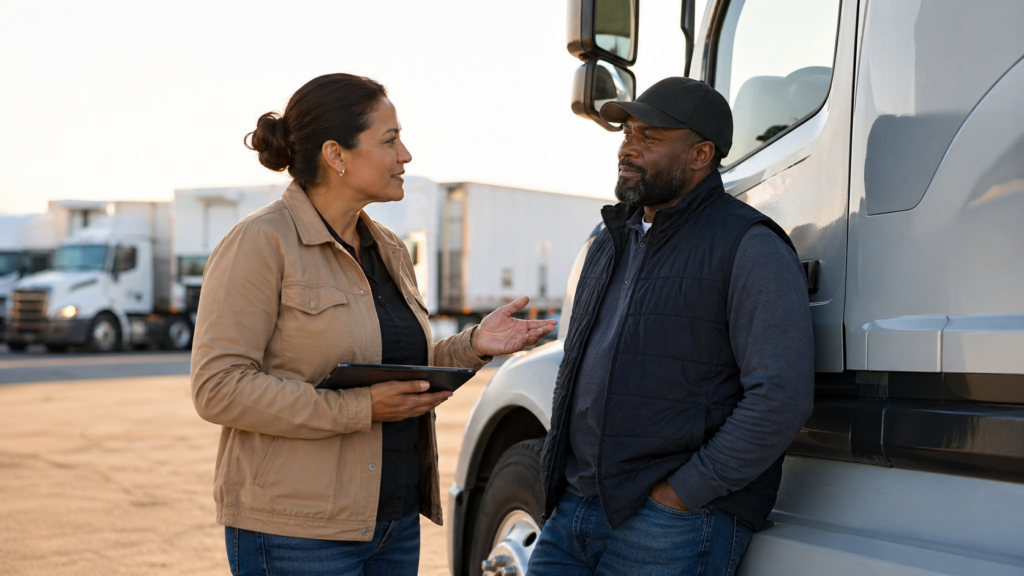
Behavior change takes explanation. It takes trust. It takes consistency. It takes follow-up. It takes a supervisor, coach, safety manager, or partner who knows how to talk to drivers in a way that actually lands. It is the result of a relationship between people.
It also takes judgment.
If you coach every individual event, you create annoyance. If you coach nothing, the data just piles up. The goal is not to police every moment. The goal is to identify patterns, address what matters, and create sustained improvement over time.
That lines up with a point we made in Extracting Underwriting Value from Telematics Data: patterns are often more useful than isolated events. The same is true for coaching. One event may be noise. Repeated behavior over weeks and months is usually where the real signal is.
This matters to fleets. It also matters to insurers and MGAs.
AI Features Are Not a Safety Strategy
If you are evaluating telematics providers, it is easy to get impressed by feature lists. AI scoring. Automated coaching. Edge processing. Instant alerts. Those things can have value. But on their own, they are not a safety strategy.
The real question is simpler: who is going to do the work that actually changes outcomes?
Who is helping the fleet get buy-in at rollout?
Who is making sure the data is being interpreted properly to translate risk signals into coaching and accountability?
Who is keeping the program from becoming shelfware six months after implementation?
A Note on Cameras
This is also part of why thoughtful restraint matters.
Many providers treat dual-facing cameras as the default. More video. More visibility. More data.
We do not think that is always necessary (and depending on what is captured can actually create additional liability).
We have seen strong results using forward-facing cameras and telematics without opening the door to in-cab video. There are privacy and other concerns there that many fleets would rather avoid, and often with good reason. You can achieve the safety outcome you want without creating another layer of friction.
Again, this comes back to judgment. The answer is not always to collect more. The answer is to collect what is helpful and then to actually do something with it.
What We See in the Field
The fleets that usually improve are the ones with a program people actually use, not the ones with the flashiest platform.
They have clear expectations. They have buy-in. They have a cadence. They have someone paying attention. They have a process for reviewing what matters and ignoring what does not. They do not confuse activity with progress.
That is why we continue to believe the same basic truth, even as the technology keeps evolving:
AI can make telematics smarter, but it cannot replace the human element required to make a program successful.
Not at rollout. Not in coaching. Not in building trust. Not in maintaining momentum. Not in taking action on observed patterns.
AI is a powerful tool, but results only come from people using that tool well.
P.S. AI is worthless if the camera is not plugged in!