
Telematics have become a must-have for modern fleets, but the conversation around them often focuses on the “what” (dashboards, reports, risk scores) rather than the “how” and “why.” Understanding what’s actually happening inside those small devices and how to interpret the data they produce can be the difference between a program that looks good on paper and one that actually delivers measurable safety and efficiency gains.
In this post, we’ll walk through the basics of telematics technology, explore why vehicle weight can skew the accelerometer data many fleets and insurers rely on, and talk about why more granular data isn’t always better. Along the way, we’ll draw from lessons in past Orion posts like Don’t Drown to help you avoid the common traps.
How Telematics Works (Without the Tech Headache)
At their core, telematics represent the marriage of informatics and telecommunications: a system for collecting data from vehicles and transmitting it to a central platform. While every vendor’s hardware is a little different, most telematics devices tap into three primary data sources:
- GPS modules track position, speed, and heading.
- Accelerometers measure changes in velocity (g-forces) along three axes, detecting events like harsh braking, aggressive turns, and rapid acceleration.
- Engine data from the vehicle’s electronic control unit (ECU) provides information like RPMs, fuel use, fault codes, and throttle position.
These inputs feed into the telematics device, which transmits data over a cellular network to a cloud platform, where it’s processed, analyzed, and made available to users via dashboards and reports.
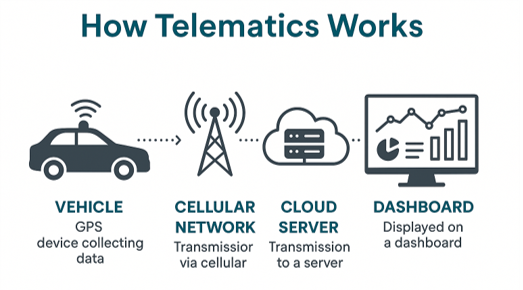
By combining location, motion, and mechanical data, telematics provide a comprehensive view of how a vehicle is being driven, not just where it is.
When Weight Changes the Story
One of the most underappreciated variables in telematics analysis is vehicle weight, and not just the gross vehicle weight rating (GVWR) you find on the spec sheet. Whether a truck is fully loaded, partially loaded, or running empty can significantly change the way accelerometer events register.
From a physics standpoint, momentum equals mass times velocity. A fully-loaded Class 8 truck at 55 mph has far more momentum than the same truck running empty. When that truck brakes hard, the actual deceleration (change in velocity per unit of time) can be lower in g-force terms because the heavier load resists the deceleration. The accelerometer might record it as a less severe event, even though the kinetic energy involved and the potential risk is higher.
The opposite is also true: an empty vehicle can safely brake harder and produce sharper g-force spikes with less brake pedal pressure simply because there’s less mass to slow down. This higher peak might cross a telematics system’s “harsh braking” threshold, even when the maneuver is well within safe operating limits. Meanwhile, a heavier vehicle in a bad situation—braking late or following too closely—may not trigger that same threshold because the deceleration curve is flatter.
The result: Without knowing the load status, the telematics system (and any human or algorithm interpreting it) can misclassify events, creating false positives in light vehicles and false negatives in heavy ones.
It’s also worth noting that not every hard-braking event is inherently negative. Sometimes, a decisive brake application is exactly the right action to avoid a collision or respond to unexpected road conditions. Telematics should be interpreted with this nuance in mind: the goal isn’t to eliminate all hard brakes, but to understand when they indicate risky driving versus when they reflect good defensive driving.
In short, accelerometer data is valuable—but without considering the variable of weight, it can mislead.
High-Resolution Data vs. the Big Picture
Modern telematics systems can capture data at incredibly high frequencies, multiple samples per second, especially when reconstructing a specific incident like a collision. This is valuable for forensic analysis, but for ongoing driver coaching and performance monitoring, you often don’t need that level of granularity (and it can be confounding and overwhelming)
Here’s why: the law of large numbers tells us that patterns emerge over time. Whether you’re sampling every second or every two minutes, a driver who consistently speeds, brakes hard, or corners aggressively will still stand out in the data.
In Don’t Drown, we discussed how overloading managers with too much granular data can bog down the coaching process. More isn’t always better, especially if it distracts from the behaviors that truly matter. For most safety programs, recording key metrics at 1- or 2-minute intervals is enough to identify trends, track improvement, and support constructive coaching conversations.
Bringing It Together: Context Is King
The real power of telematics lies in combining technical accuracy with operational context:
- Technical accuracy means the sensors are working properly, data is clean, and the system is calibrated.
- Operational context means understanding that a harsh-braking event in an empty van isn’t the same as one in a fully loaded dump truck—and that a week’s worth of 2-minute samples can tell the same story as thousands of 1-second samples.
Taking this approach not only builds trust with drivers, it also leads to safer driving, fewer claims, and lower premiums. When fleets and insurers interpret telematics data through both lenses, they make better decisions. Coaching becomes more targeted and everyone gains more trust in the system.
Final Thoughts
Telematics have matured into an indispensable fleet management and risk mitigation tool. But like any tool, its value depends on how it’s used. Knowing how the technology works, understanding the nuances of accelerometer data, and choosing the right sampling frequency can turn a sea of raw numbers into actionable insight.
At Orion, we believe that the best telematics programs balance precision with practicality. They measure what matters, interpret it in context, and focus on outcomes: safer drivers, fewer losses, and stronger, less costly fleet performance.